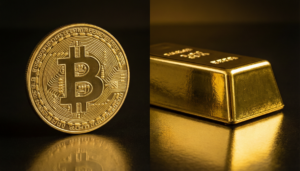
Bitcoin is routinely called “digital gold,” which is a useful shorthand and also an oversimplification. The two assets share a scarcity story but differ sharply almost everywhere else. Here’s a fair, feature-by-feature look.
Scarcity
Bitcoin’s 21 million cap is absolute and known in advance. Gold’s supply is finite in practice but not in theory — more can always be mined, and total above-ground supply keeps growing by roughly 1.5% a year. Bitcoin’s scarcity is mathematically guaranteed; gold’s is geologically constrained.
Portability and divisibility
A billion dollars of Bitcoin can be sent across the planet in minutes and held in a password. A billion dollars of gold weighs roughly 13 tonnes and needs vaults, insurance, and transport. On pure portability, Bitcoin wins decisively — though that same portability makes it easier to lose access to permanently.
Track record
Gold has functioned as money or a store of value for thousands of years across essentially every civilization. Bitcoin has existed since 2009. This doesn’t make Bitcoin’s case invalid, but it does mean gold’s role is tested across wars, currency collapses, and regime changes in a way Bitcoin has not yet been.
Volatility
Gold’s annual volatility typically sits in the mid-teens percentage-wise. Bitcoin’s has historically run several multiples higher, with drawdowns of 70–80% having occurred more than once. That volatility cuts both ways — larger upside, larger downside — and matters a lot depending on the holding period.
Regulatory and custody risk
Gold ownership is legally unambiguous almost everywhere. Bitcoin’s regulatory treatment still varies by country and continues to evolve. Custody is different too: losing a private key is unrecoverable, while gold’s physical risks (theft, storage) are older, more familiar problems with established insurance markets.
The honest conclusion
Neither asset makes the other redundant. Gold offers a longer track record and lower volatility; Bitcoin offers portability and a harder mathematical scarcity guarantee. Many investors who hold one for its non-correlation to stocks are increasingly holding a bit of both for the same reason.