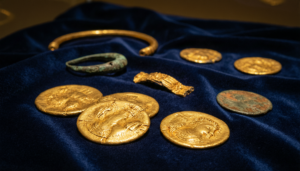
Gold’s monetary role wasn’t decided by a single government or committee — it emerged independently across civilizations that had no contact with each other, which is part of why economists treat it as a special case rather than an arbitrary choice.
Why gold, specifically
Early societies needed money that was durable, divisible, portable, and hard to counterfeit or produce in large new quantities. Gold happens to satisfy all four better than almost anything else found in nature — it doesn’t corrode, it can be melted and reshaped without losing value, and meaningful new supply requires real mining effort.
From coins to certificates
The first standardized gold coins appeared around the 6th century BCE in Lydia (modern Turkey). Over the following centuries, most major economies adopted some form of gold coinage, and eventually paper certificates redeemable for gold, since carrying coins for large transactions was impractical.
The gold standard era
By the late 19th century, most major currencies were formally pegged to a fixed amount of gold — a system known as the gold standard. It constrained how much money governments could print, since currency in circulation was theoretically backed by gold reserves.
Bretton Woods and its collapse
After World War II, the Bretton Woods agreement pegged the US dollar to gold and other currencies to the dollar. That system ended in 1971 when the US suspended dollar-to-gold convertibility — the event known as the “Nixon Shock” — moving the world onto the fiat currency system used today, where money isn’t backed by a physical commodity at all.
Gold’s role since 1971
Freed from being a currency peg, gold became a freely traded asset and reserve holding rather than the literal backbone of money. Central banks kept holding it anyway, and have been net buyers again over the past decade — a sign that even in a fully digital financial system, the case for an asset with no counterparty hasn’t gone away.